TL;DR — A phishing campaign is impersonating the Government of India / Income Tax Department (“कर दंड सूचना – भारत सरकार” / Tax Penalty Notice) to deliver ValleyRAT. Victims receive emails from free webmail providers (Proton Mail, Yahoo, etc.), click through to a freshly‑registered lure domain, and download
Tax-Number70863.zip. The ZIP contains an ISO image (Tax-Number70863.iso) — a classic Mark‑of‑the‑Web bypass — which, when mounted, presents a single executable disguised with a fake Google Chrome icon to mislead the user into running it. The payload establishes persistence via a Run key and COM hijacking, injects intongen.exe, drops a kernel driver, steals browser credentials, and beacons to a raw‑IP C2 on103.59.103[.]30:8888.
This is a defensive threat‑intelligence writeup. All malicious indicators below are defanged. Do not re‑arm and visit them on a production machine.
1. Why this campaign matters
ValleyRAT (a remote access trojan historically associated with China‑nexus activity and Chinese‑speaking targets) is increasingly being repurposed against Indian victims. I came across this sample while hunting for India‑themed tax lures — the phishing page is squarely aimed at Indian taxpayers, impersonating the Income Tax Department / Government of India with a fake “tax penalty” notice, and the delivery leans on free, high‑reputation webmail to slip past sender‑reputation filtering.
I pulled the sample and detonated it manually in my sandbox environment on 2026‑06‑24. Here’s what I found:
| Field | Value |
|---|---|
| Family | ValleyRAT (valleyrat_s2) |
| Classification | Malicious — backdoor, stealer, spyware |
| Capabilities | persistence, privilege escalation, discovery, credential theft |
| Analysis platform | Windows 11 (isolated VM) |
| Analysis date | 2026‑06‑24 |
| Tooling | Process Monitor, Wireshark, API Monitor, manual registry review |
2. Delivery: phishing from free webmail
The campaign is distributed through phishing emails sent from free webmail accounts — Proton Mail, Yahoo, and similar providers. Using legitimate, well‑reputed mail infrastructure (rather than attacker‑owned domains) helps the messages pass SPF/DKIM/DMARC alignment for the sending domain and avoids the reputation penalties that newly‑registered sender domains attract.
The emails carry a government/tax‑penalty theme and link to an attacker‑controlled lure page. From there the chain is entirely web‑delivered — no malicious attachment is needed in the email body itself, which further reduces detonation at the mail gateway.
3. The lure page
The URL I detonated was:
hxxps://laiwnndye[.]love
The page impersonates an Indian government tax‑penalty notice. I cross‑referenced it on urlscan.io, which flagged it Potentially Malicious, explicitly noting it targets the Indian Government brand.
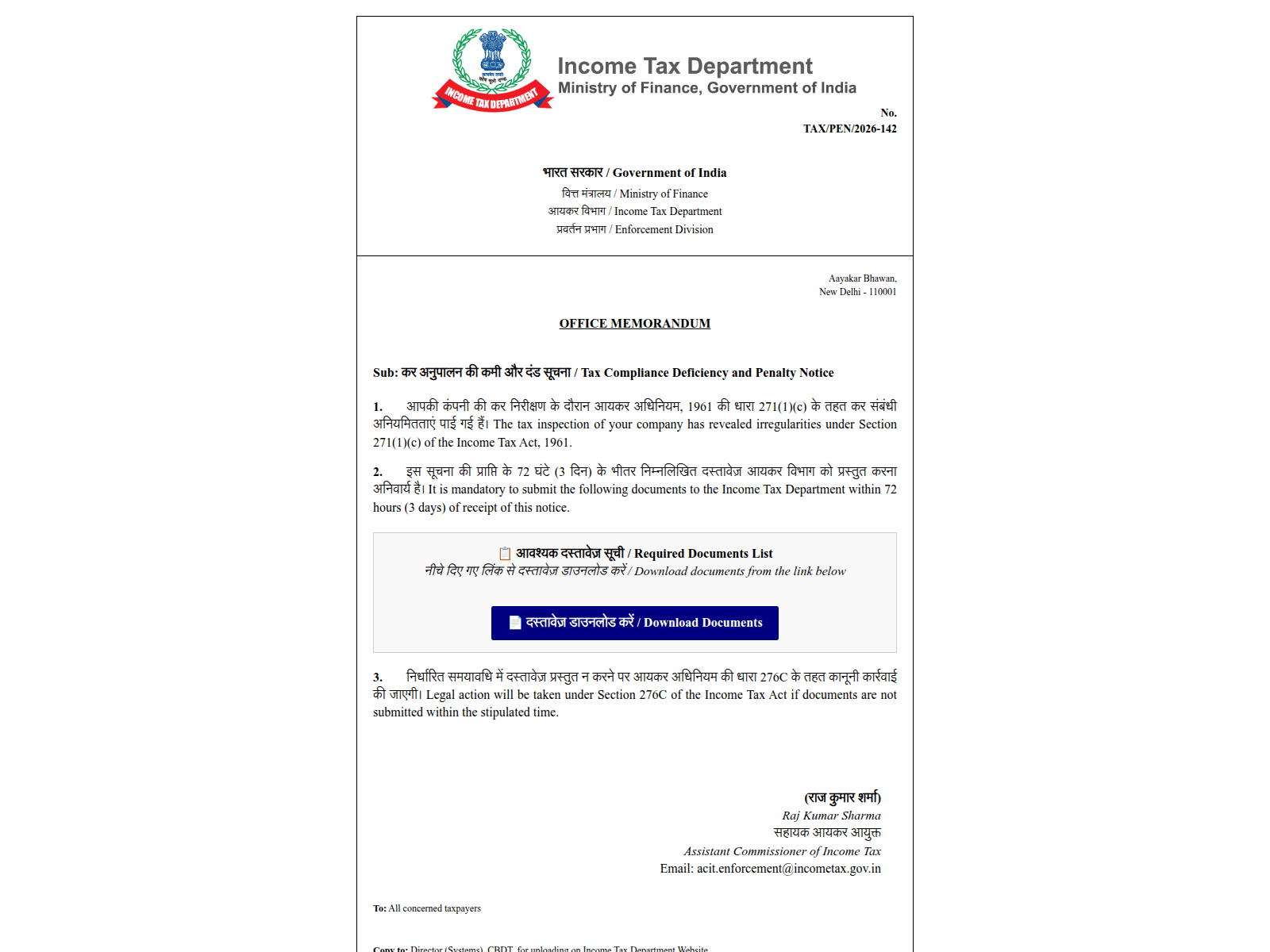
The lure is a polished bilingual (Hindi/English) “Office Memorandum” engineered to manufacture authority and urgency:
- Impersonates: Income Tax Department, Ministry of Finance, Government of India — “Enforcement Division”, Aayakar Bhawan, New Delhi – 110001, complete with the official emblem.
- Reference number:
TAX/PEN/2026-142— a fabricated case ID for legitimacy. - Subject: “कर अनुपालन की कमी और दंड सूचना / Tax Compliance Deficiency and Penalty Notice.”
- Pretext: claims a tax inspection found irregularities under Section 271(1)(c) of the Income Tax Act, 1961.
- Urgency: demands documents be submitted within 72 hours (3 days), threatening legal action under Section 276C otherwise.
- Spoofed authority: signed “Raj Kumar Sharma, Assistant Commissioner of Income Tax”; sender
[email protected][.]in; addressed “To: All concerned taxpayers.”
The deadline‑plus‑legal‑consequence framing is textbook social engineering — it pressures the target into clicking before verifying. The page presents a bilingual download prompt — "📄 दस्तावेज़ डाउनलोड करें / Download Documents" — that points to a second‑stage delivery host:
hxxps://pzidiauwytsd[.]eu[.]cc/d/0a2044b83ca0
Infrastructure indicators
| Indicator | Detail |
|---|---|
| Lure domain | laiwnndye[.]love |
| Lure IP | 103.23.172[.]117 : 443 |
| Delivery domain | pzidiauwytsd[.]eu[.]cc |
| Delivery IP | 103.23.172[.]118 : 443 |
| Hosting ASN | AS997 — BSL-AS-AP, Beyotta Services LLP |
| Domain created | 2026‑06‑19 (≈4 days before analysis) |
| Registrar | Gname.com Pte. Ltd. |
| TLS cert | Issued by YR1 on 2026‑06‑22, valid 3 months |
Note the two delivery hosts are adjacent IPs in the same /24 (.117 and .118) on the same ASN — a small, disposable, single‑purpose infrastructure cluster typical of short‑lived phishing waves. The .love and .eu.cc TLDs are cheap/free and routinely abused.
4. Attack chain at a glance
  Phishing email                Free webmail (Proton / Yahoo / …)
  "Income Tax penalty"   ──────────────────────────────────────┐
                                                                ▼
  laiwnndye[.]love  ── "Download Documents" ──►  pzidiauwytsd[.]eu[.]cc/d/...
   (fake IT notice)                                   │
                                                       ▼
                                       Tax-Number70863.zip   (Mark-of-the-Web)
                                                       │  unzip
                                                       ▼
                                       Tax-Number70863.iso   (MOTW bypass)
                                                       │  double-click → mount as E:\
                                                       ▼
                                       Tax-Number70863.exe   (fake Chrome icon)
                                                       │     ValleyRAT loader
                         ┌─────────────────────────────┼───────────────────────────┐
                         ▼                              ▼                           ▼
              Persistence                     Defense evasion              Collection / C2
   • Run key  HKLM\...\Run\USB3YT     • Inject → ngen.exe                • Steal browser creds
   • COM hijack (2x CLSID)              (SetThreadContext +                 & cookies
   • Task Scheduler COM                 WriteProcessMemory)              • Keylog (SetWindowsHookEx)
                                       • Drop driver pcdhost.sys         • Beacon 103.59.103[.]30:8888
                                       • Anti-sandbox disk/SCSI checks
5. Host behaviour (what I observed)
5.1 Download & execution
I navigated to the lure URL in my sandbox using Edge:
msedge.exe --start-maximized --simulate-outdated-no-au='Tue, 31 Dec 2099 23:59:59 GMT' --single-argument https://laiwnndye.love
The ZIP landed in Downloads carrying a Zone.Identifier Alternate Data Stream — i.e., Mark‑of‑the‑Web (MOTW), confirming an internet download:
C:\Users\<user>\Downloads\Tax-Number70863.zip (NTFS ADS: Zone.Identifier)
Extracting the ZIP, I found it doesn’t contain an executable directly — instead it holds an ISO disk image, Tax-Number70863.iso. This is a deliberate MOTW bypass (T1553.005): while the outer ZIP carries the Zone.Identifier, files inside a mounted ISO volume do not inherit MOTW. This means SmartScreen and other MOTW‑aware defenses will not prompt/block when the user runs the payload.
When I double‑clicked the ISO, Windows mounted it as a virtual drive (E:\). Inside was a single file:
Tax-Number70863.exe — disguised with a fake Google Chrome icon to appear as a harmless browser shortcut rather than an executable.
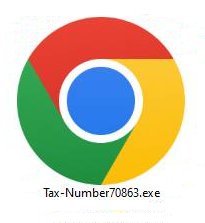
This icon masquerading (T1036.005) is a simple but effective trick — a non‑technical user sees the familiar Chrome logo and double‑clicks without suspicion. The E:\ drive letter in my sandbox logs confirms the ISO‑mount delivery path:
\??\E:\Tax-Number70863.exe
Once executed, the loader copies itself to a persistent staging directory:
C:\ProgramData\USB3YT\Tax-Number70863.exe
5.2 Persistence — belt and braces
Checking the registry and scheduled tasks after execution, I found ValleyRAT had installed two independent persistence mechanisms:
- Registry Run key (T1547.001):
HKLM\SOFTWARE\Microsoft\Windows\CurrentVersion\Run\USB3YT = cmd /c start "" /D "C:\ProgramData\USB3YT" Tax-Number70863.exe - COM hijacking (T1546.015) — writing
LocalServer32under attacker CLSIDs so a legitimate COM lookup loads the payload:
It additionally touches the Task Scheduler COM API and a Windows TerminalHKCU\...\CLSID\{DFF20505-B08F-455B-AD70-4FBD055088E0}\LocalServer32 HKCU\...\CLSID\{018D5C66-4533-4307-9B53-224DE2ED1FE6}\InstanceStartTerminalOnLoginTask.
5.3 Defense evasion & injection
Monitoring API calls and process activity, I observed:
- Process injection into
ngen.exe(the .NET Native Image Generator, a signed Microsoft binary) viaSetThreadContext+WriteProcessMemory— a living‑off‑the‑land host for the implant. I also captured calls toNtCreateUserProcessBlockNonMicrosoftBinary. - Drops a kernel driver:
C:\Windows\System32\drivers\pcdhost.sysand exercisesLoadsDriver— a potential kernel/BYOVD component for tamper protection or privilege work. - Anti‑sandbox / discovery: I noticed it enumerating physical disks and SCSI/CD‑ROM registry keys (e.g. checking for
Msft Virtual DVD-ROMand the disk modelWDC WDS100T2B0A), system language, time zone, and connected drives — classic VM/sandbox fingerprinting before committing.
5.4 Collection — stealer + spyware
On the collection side, I saw:
- Browser credential/cookie theft (T1555.003): it read Chrome/Edge
User Datadirectories, and I observed it invoking Edge helper binariescookie_exporter.exeandidentity_helper.exe. - Keylogging / UI surveillance: I caught
SetWindowsHookEx,GetForegroundWindowSpam, andSendNotifyMessagecalls — clear indicators of keystroke logging and window monitoring. - Local file harvesting (T1005 / T1552.001 — credentials in files).
5.5 Command & control
Watching the network traffic in Wireshark, I saw the implant beacon out to a raw‑IP C2 with no associated domain on a non‑standard port:
103.59.103[.]30 : 8888 (TCP, Hong Kong)
The absence of a domain, the high port, and the repeated TCP sessions I captured are strong tells for ValleyRAT second‑stage C2 — and a clean network detection opportunity.
6. MITRE ATT&CK mapping
| Tactic | Technique | ID |
|---|---|---|
| Persistence | Registry Run Keys / Startup Folder | T1547.001 |
| Persistence / Priv‑Esc | Event Triggered Execution: COM Hijacking | T1546.015 |
| Defense Evasion | Masquerading: Match Legitimate Name or Location | T1036.005 |
| Defense Evasion | Subvert Trust Controls: Mark‑of‑the‑Web Bypass | T1553.005 |
| Defense Evasion | Modify Registry | T1112 |
| Defense Evasion | Process Injection (SetThreadContext) | T1055 |
| Credential Access | Credentials from Web Browsers | T1555.003 |
| Credential Access | Unsecured Credentials: Credentials In Files | T1552.001 |
| Discovery | System Information Discovery | T1082 |
| Discovery | Peripheral Device Discovery | T1120 |
| Discovery | Query Registry | T1012 |
| Discovery | System Language / Location Discovery | T1614.001 |
| Discovery | System Time Discovery | T1124 |
| Collection | Data from Local System | T1005 |
| Command & Control | Non‑Standard Port | T1571 |
7. Indicators of Compromise (defanged)
Network
| Type | Indicator | Role |
|---|---|---|
| Domain | laiwnndye[.]love |
Lure / fake IT notice |
| Domain | pzidiauwytsd[.]eu[.]cc |
Payload delivery |
| IPv4 | 103.23.172[.]117 |
Lure host (AS997) |
| IPv4 | 103.23.172[.]118 |
Delivery host (AS997) |
| IPv4:port | 103.59.103[.]30:8888 |
C2 (high confidence) |
| URL | hxxps://pzidiauwytsd[.]eu[.]cc/d/0a2044b83ca0 |
Download link |
Files
| File | Hash |
|---|---|
Tax-Number70863.zip |
MD5 2e6ffddcc1d92de656f02c290fde19a3 |
SHA256 6d2313dc89baa6e441ce951f20201ed91355d22865fe7d85bfa5ffdcd059095c |
|
Tax-Number70863.iso (MOTW bypass) |
SHA256 461f17b954e9d24b6f2164f99146b6b28cfea49dfce8dbbb5130b885ba814973 |
Tax-Number70863.exe (payload) |
MD5 bf62f6760a9b86f66822fa59140aef8b |
SHA256 1fae7d654695f7c4e0f4bb8a42a4c33137652effc360b998708c6ffcac1380e6 |
|
pcdhost.sys (driver) |
MD5 78518c0636da8f3bf1bbeefbeb2b4920 |
SHA256 7b3f8fa5844d829142002d47c2df8573c7d67defe4171414c6a015a38afe55f5 |
|
debug.log |
MD5 0a1ba01c1cdb537dee737d41b31f1cdb |
SHA256 d087c3f0036b7e4f4c114852ba17469f2e79e491b5e9fc21b498e399c59b3f71 |
Host artifacts
C:\Users\<user>\Downloads\Tax-Number70863.zip   (Zone.Identifier ADS)
C:\Users\<user>\Downloads\Tax-Number70863.iso   (mounted as E:\)
C:\ProgramData\USB3YT\Tax-Number70863.exe
C:\ProgramData\USB3YT\debug.log
C:\Windows\System32\drivers\pcdhost.sys
\??\E:\Tax-Number70863.exe

Run key:   HKLM\SOFTWARE\Microsoft\Windows\CurrentVersion\Run\USB3YT
COM CLSID: {DFF20505-B08F-455B-AD70-4FBD055088E0}
COM CLSID: {018D5C66-4533-4307-9B53-224DE2ED1FE6}
Injection target: C:\Windows\Microsoft.NET\Framework\v4.0.30319\ngen.exe
8. Detection & hunting (KQL — Microsoft Defender / Sentinel)
1) ProgramData executable launched via cmd /c start (staging + persistence pattern):
DeviceProcessEvents
| where FileName =~ "cmd.exe"
| where ProcessCommandLine has_all ("start", @"C:\ProgramData\")
        and ProcessCommandLine has ".exe"
| project Timestamp, DeviceName, AccountName, ProcessCommandLine, InitiatingProcessFileName
2) Suspicious Run‑key persistence pointing into ProgramData:
DeviceRegistryEvents
| where ActionType == "RegistryValueSet"
| where RegistryKey has @"\CurrentVersion\Run"
| where RegistryValueData has @"C:\ProgramData\"
| project Timestamp, DeviceName, RegistryKey, RegistryValueName, RegistryValueData
3) Beacon to the C2 (IP and/or unusual port 8888):
DeviceNetworkEvents
| where RemoteIP == "103.59.103.30" or RemotePort == 8888
| where InitiatingProcessFileName !in~ ("known-good-proxy.exe")
| project Timestamp, DeviceName, InitiatingProcessFileName, RemoteIP, RemotePort, RemoteUrl
4) ngen.exe making outbound network connections (it normally shouldn’t):
DeviceNetworkEvents
| where InitiatingProcessFileName =~ "ngen.exe"
| project Timestamp, DeviceName, InitiatingProcessFolderPath, RemoteIP, RemotePort
5) New driver dropped into System32\drivers:
DeviceFileEvents
| where ActionType == "FileCreated"
| where FolderPath has @"\System32\drivers\" and FileName endswith ".sys"
| where InitiatingProcessFolderPath has @"C:\ProgramData\"
| project Timestamp, DeviceName, FileName, SHA256, InitiatingProcessFileName
Additional hunt ideas
- COM hijack: alert on
HKU\...\CLSID\{...}\LocalServer32writes whose data resolves intoProgramDataor a user‑writable path. - Hash‑match the IOCs above in
DeviceFileEvents/DeviceImageLoadEvents. - Flag ZIP/EXE downloads bearing
Zone.Identifierthat execute fromProgramDatawithin a short window.
9. Recommendations
- Email: don’t trust government/tax themes by topic alone — verify sender domain and DMARC; treat “download the attached/linked notice” tax lures as hostile by default. Free‑webmail senders claiming to be a government department are a red flag.
- Block/monitor the IOCs above; alert on outbound
:8888to unrecognised hosts. - Harden Run‑key and COM CLSID writes; monitor driver installs from non‑standard parents.
- Mark‑of‑the‑Web matters: keep SmartScreen/attachment‑MOTW enforcement on; investigate MOTW‑tagged files executing from
ProgramData. - User awareness: India‑specific Income Tax / penalty phishing is an active theme — reinforce that the IT Department does not distribute “penalty notices” as downloadable executables.
10. References
- urlscan.io scan —
laiwnndye[.]love(verdict: Potentially Malicious; targets Indian Government) - MITRE ATT&CK — Enterprise v16
I performed this analysis by manually detonating the sample in my isolated sandbox environment, capturing network traffic with Wireshark, monitoring process/registry activity with Process Monitor and API Monitor, and enriching infrastructure indicators via urlscan.io and WHOIS. All indicators are defanged; re‑arm only in an isolated lab.